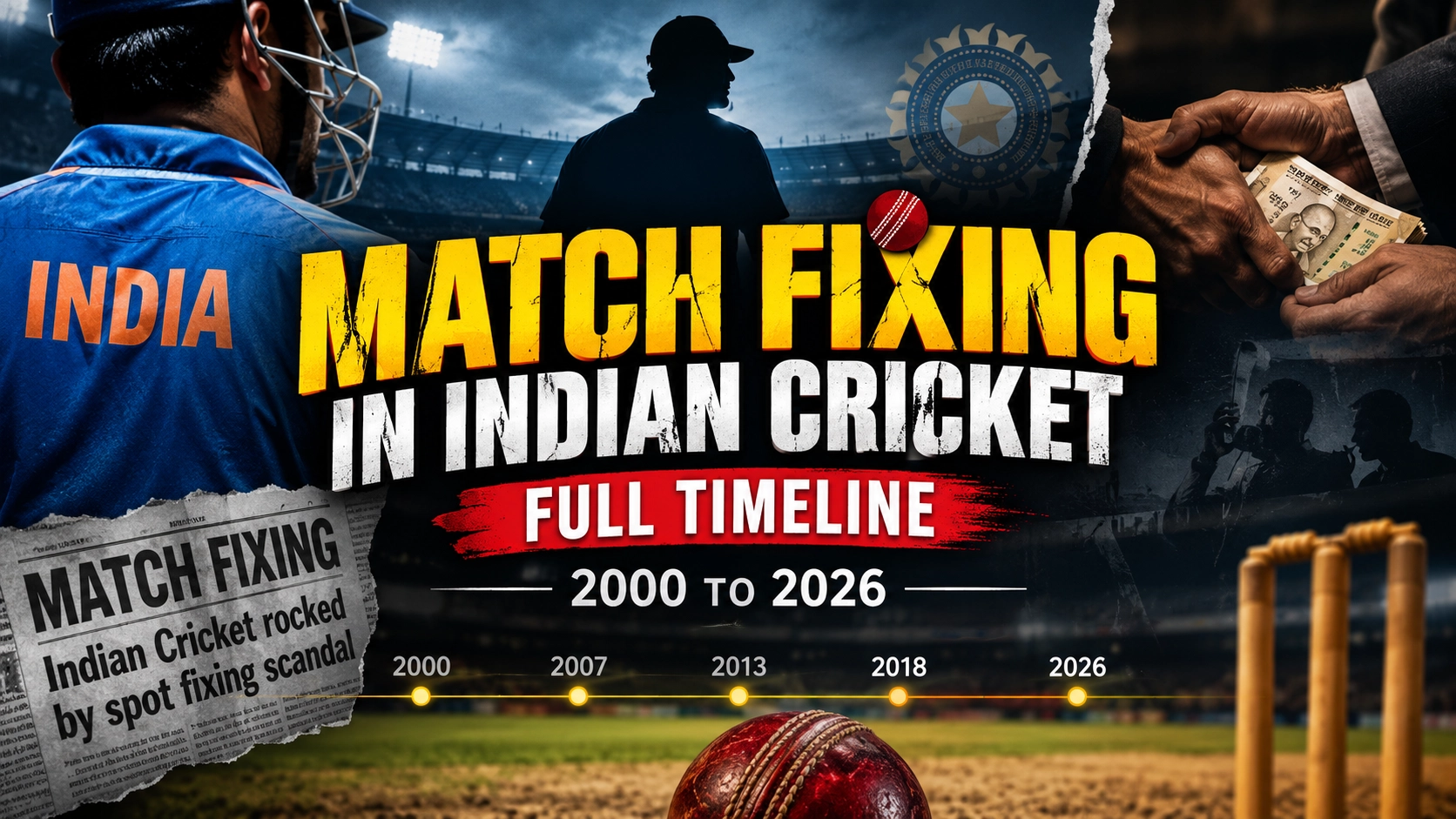
Short answer: Indian cricket has lived with match fixing for over a quarter of a century. The story runs from the Delhi Police tapes that exposed Hansie Cronje in April 2000, through the life bans on Mohammad Azharuddin and Ajay Sharma, the 2012 domestic sting, the 2013 IPL spot-fixing arrests and the two-year suspensions of Chennai Super Kings and Rajasthan Royals, to the state T20 league scandals of 2019 onward and the BCCI's 2025 request that the Supreme Court finally make fixing a crime. This timeline lists every major event, year by year, with what actually happened to the people involved.
If you want the definitions first, read our explainer on what match fixing is and how it is detected.
Before 2000: the rumours
Fixing did not begin in 2000; that is just when it was proven. Through the 1990s, Indian and Pakistani players privately alleged that teammates were in touch with bookmakers. Manoj Prabhakar claimed in 1997 that a teammate had offered him money to underperform in a 1994 match in Sri Lanka; the BCCI's Chandrachud inquiry that year found nothing it could act on. Pakistan's Qayyum Commission, published in 2000, led to a life ban for Salim Malik and set the template for what was about to happen in India.
2000: the Cronje tapes and the first bans
- April 2000. Delhi Police, investigating an extortion case, recorded South Africa captain Hansie Cronje speaking to a bookmaker, Sanjeev Chawla, during the ODI series in India. Cronje admitted taking money and was banned for life by South Africa.
- May to October 2000. The Indian government ordered a CBI inquiry. Its report, released in November, named several Indian players and officials and concluded that fixing was widespread in the 1990s.
- December 2000. Acting on the CBI report, the BCCI banned Mohammad Azharuddin and Ajay Sharma for life, and Ajay Jadeja and Manoj Prabhakar for five years. Team physiotherapist Ali Irani was also banned for five years.
2001 to 2011: the quiet decade
- 2003. The Delhi High Court set aside Ajay Jadeja's ban. He never played for India again but returned to domestic cricket briefly.
- 2008. The IPL launched. Within two seasons the sheer size of its betting market, almost all of it illegal in India, made it the obvious target for fixers.
- 2010. The Lord's spot-fixing case in England (Pakistan's Salman Butt, Mohammad Asif and Mohammad Amir) proved that single deliveries were being sold. Indian anti-corruption officials privately acknowledged the same tactics were being tried in domestic T20 cricket.
2012: the domestic sting and Azharuddin's reprieve
- May 2012. A television sting operation filmed five domestic players discussing spot fixing and under-the-table payments. The BCCI banned T. P. Sudhindra for life, Shalabh Srivastava for five years, and Mohnish Mishra, Amit Yadav and Abhinav Bali for one year each. Mishra was dropped by his IPL franchise.
- November 2012. The Andhra Pradesh High Court set aside Azharuddin's twelve-year-old life ban, ruling that the BCCI's process had been flawed. He was never formally cleared of the allegations, but he was free to hold office and later became president of the Hyderabad Cricket Association.
2013: the IPL spot-fixing scandal
The single biggest event on this list.
- 16 May 2013. Delhi Police arrested Rajasthan Royals players S. Sreesanth, Ajit Chandila and Ankeet Chavan on charges of spot fixing in three IPL matches, alongside several alleged bookmakers.
- 24 May 2013. Mumbai Police arrested Gurunath Meiyappan, Chennai Super Kings team principal and son-in-law of BCCI president N. Srinivasan, for betting on IPL matches and passing on team information. Rajasthan Royals co-owner Raj Kundra was questioned over betting shortly afterwards.
- September 2013. The BCCI's disciplinary committee banned Sreesanth and Chavan for life, Amit Singh for five years and Siddharth Trivedi for one year for failing to report an approach. Chandila's hearing was deferred and he was later banned for life as well.
- The fallout. Srinivasan was forced to step aside as BCCI president while the investigation ran. The Supreme Court appointed the Mudgal Committee to investigate, and the Mudgal report (2014) found Meiyappan and Kundra guilty of betting.
2015: Lodha, suspensions and a court discharge
- 14 July 2015. The Supreme Court-appointed Lodha Committee suspended Chennai Super Kings and Rajasthan Royals from the IPL for two seasons (2016 and 2017) and banned Meiyappan and Kundra from cricket for life. Two new franchises, Rising Pune Supergiant and Gujarat Lions, filled the gap.
- 25 July 2015. A Delhi court discharged all 36 accused in the criminal case, including Sreesanth, Chandila and Chavan, ruling that the organised-crime law (MCOCA) used by police did not apply and that the evidence did not support criminal charges. The BCCI's bans, which are a matter of its own code, remained in place.
This split, cleared in court but banned by the board, is the defining feature of Indian fixing cases, and the reason the legal question came back a decade later.
2016 to 2018: pitch fixing and new rules
- 2016. The Lodha reforms reshaped BCCI governance and strengthened its Anti-Corruption Unit, giving it a formal mandate and an officer attached to each IPL team.
- October 2017. Pune curator Pandurang Salgaoncar was suspended after a television sting filmed him promising to prepare a pitch to order before an India–New Zealand ODI. Pitch fixing entered the Indian vocabulary.
- May 2018. An Al Jazeera documentary alleged that pitches in Galle (Sri Lanka) and Pune had been doctored for betting purposes and that fixers had approached players in several countries. The ICC investigated the claims; the BCCI said its Pune pitch had already been examined after the 2017 sting.
- 2018. The BCCI adopted a revised anti-corruption code aligned with the ICC's, with mandatory reporting and minimum bans for non-reporting.
2019: the state leagues and Sreesanth's return
- August 2019. The BCCI ombudsman reduced Sreesanth's life ban to seven years, ending in September 2020. He returned to Kerala's domestic side in 2021 before retiring.
- October 2019. The ICC banned Bangladesh captain Shakib Al Hasan for two years (one suspended) for failing to report approaches from an Indian bookmaker, Deepak Aggarwal, including before an IPL match for Sunrisers Hyderabad.
- November 2019. Bengaluru Police arrested former India wicketkeeper C. M. Gautam and Abrar Kazi for allegedly fixing the Karnataka Premier League (KPL) final, and the owner of the Bellary Tuskers franchise for betting-linked offences. Several other players, a coach and a team owner were charged. The BCCI suspended the KPL.
2020 to 2022: extradition and a legal reversal
- February 2020. Sanjeev Chawla, the bookmaker on the Cronje tapes, was extradited from the UK to India after a seven-year legal fight, the first extradition in a cricket-corruption case. He was granted bail within months.
- 2020. Tamil Nadu Premier League players reported approaches from bookmakers; the BCCI unit investigated, and the league tightened phone and dressing-room rules.
- January 2022. The Karnataka High Court quashed the criminal proceedings in the KPL case, holding that match fixing was a breach of the BCCI's code of conduct, not an offence under the Indian Penal Code, and that discipline was the board's job. The Karnataka government appealed to the Supreme Court.
2023 to 2024: the T20 league era
- 2023. The ICC charged eight people, including former internationals, over fixing in the Abu Dhabi T10 league; the case highlighted how Indian bookmakers had moved their approaches into overseas franchise leagues, where many Indian-origin players and officials were involved.
- November 2023. Marlon Samuels was banned for six years for accepting money and gifts from an Indian businessman and failing to report it, the third former international (after Heath Streak and Brendan Taylor) sanctioned over the same network.
- 2024. The BCCI's Anti-Corruption Unit focused its attention on the fast-growing state T20 leagues, where player pay is low, owners are new to cricket, and bookmakers have found access easier than in the IPL.
2025: the BCCI asks for a law
- April 2025. During IPL 2025 the BCCI's Anti-Corruption and Security Unit issued a formal warning to all franchises, players and support staff to avoid a Hyderabad-based businessman suspected of links to bookmakers who had been trying to meet players.
- October 2025. The BCCI filed to intervene in the Supreme Court appeal arising from the KPL case, arguing that match fixing amounts to cheating by deception under Indian criminal law and should be prosecuted as such. The Court allowed the intervention and appointed an amicus curiae to assist. It is the first time the board has formally asked for fixing to be treated as a crime.
2026: where things stand
- The Supreme Court's decision on whether match fixing is a criminal offence in India was still pending when this article was written. If it rules for the Karnataka government and the BCCI, the 2015 and 2022 discharges would no longer be the template, and police cases against fixers would become far easier.
- The BCCI unit now monitors every match of every state T20 league, not just the IPL, and has said franchise owners will be sanctioned alongside players if found guilty. The move followed fresh reports of bookmakers contacting players, owners and team managers in the Tamil Nadu Premier League.
- India still has no dedicated anti-fixing statute. The Prevention of Sporting Fraud Bill, drafted in 2013, was never passed.
What the timeline tells you
Three patterns run through 26 years:
- The target moves to wherever scrutiny is weakest. International cricket in the 1990s, the IPL in its early years, then domestic and state leagues once the IPL tightened up.
- Boards punish, courts do not. Almost every Indian player banned for fixing has been discharged or never charged in court, because fixing is not a crime. That gap is what the 2025 Supreme Court case is about.
- Most bans are for silence, not fixing. Since the 2018 code, failing to report an approach has produced more sanctions than proven fixing, in India and worldwide.
If you follow cricket predictions, this history is the best argument for following analysis you can see and check, like the IPL predictions and toss analysis that Amit Majithia publishes with his reasoning, and for treating anyone claiming to know a "fixed" result as a fraud. For the players involved in the biggest cases, see our profile of high-profile players involved in match fixing allegations.
Frequently asked questions
Which Indian cricketers have been banned for match fixing?
Mohammad Azharuddin and Ajay Sharma (life bans, 2000; Azharuddin's was set aside in 2012), Ajay Jadeja and Manoj Prabhakar (five years, 2000), T. P. Sudhindra (life, 2012), Shalabh Srivastava (five years, 2012), S. Sreesanth and Ankeet Chavan (life, 2013; Sreesanth's reduced to seven years), Ajit Chandila (life) and Amit Singh (five years, 2013), among others.
Was Sreesanth found guilty of match fixing?
A Delhi court discharged him of criminal charges in 2015. The BCCI, applying its own anti-corruption code, found him guilty of spot fixing and banned him for life, a ban its ombudsman reduced to seven years in 2019. Both statements are true: he was cleared in court and sanctioned by the board.
Why were CSK and RR suspended from the IPL?
The Lodha Committee found in 2015 that Gurunath Meiyappan (CSK) and Raj Kundra (RR) had bet on IPL matches, which brought the game into disrepute under the IPL's rules. Both franchises were suspended for the 2016 and 2017 seasons and both officials were banned for life.
Is match fixing illegal in India?
Not as a specific offence, as of 2026. Cases have been brought under general cheating and conspiracy laws and have mostly failed. The Supreme Court is deciding, in an appeal from the Karnataka Premier League case, whether fixing counts as criminal cheating. The BCCI has argued that it should.
Has the IPL had a fixing case since 2013?
No player has been banned for fixing an IPL match since 2013. The BCCI unit has investigated approaches and issued warnings, most recently in 2025, but the proven cases since then have been in state leagues and overseas T20 and T10 competitions.